Comparative Analysis of AZ150 vs AZ100 Coating on Light Steel for Chemical Plants and Coastal Areas: Impact on Building Life-Cycle Cost
1. Introduction
In the modern construction industry, light steel with a zinc-aluminium protective coating (AZ coating) has become the primary choice for roof structures, especially in highly corrosive environments such as chemical plants and coastal areas. PT. Bajaringan Industri Sejahtera, as a pioneer of light steel roofing solutions in Indonesia, consistently educates the market on the importance of selecting the right coating specifications to ensure long-term durability and cost efficiency.
The difference in coating thickness between AZ150 (150 g/m²) and AZ100 (100 g/m²) may seem visually small, but its impact on corrosion resistance and the life-cycle cost (LCC) of a building is very significant. This article analyzes the comparison of both technically and economically, providing data-based recommendations for industry players, consultants, and project owners in the chemical and coastal sectors.
2. Key Points
Point 1: Technical Characteristics of AZ150 and AZ100 Coating
Sub-point 1.1: Definition and Composition of AZ Coating
AZ coating, also known as Aluzinc, is an alloy layer consisting of 55% aluminium, 43.4% zinc, and 1.6% silicon. This combination combines aluminium's resistance to atmospheric corrosion with the cathodic protection of zinc. Silicon is added to improve the adhesion of the layer to the steel substrate and prevent adverse chemical reactions during the hot-dip process.
Sub-point 1.2: Differences in Coating Thickness
- AZ150: Has a nominal coating mass of 150 g/m² (equivalent to a thickness of about 20 µm per side).
- AZ100: Has a nominal coating mass of 100 g/m² (equivalent to a thickness of about 13 µm per side).
This 50 g/m² difference directly affects the amount of protective material available to neutralize corrosion attack. The thicker the layer, the longer it takes for corrosion to penetrate the steel substrate.
Sub-point 1.3: Relevant International Standards
Light steel products of PT. Bajaringan Industri Sejahtera are manufactured according to international standards:
- ASTM A792/A792M: Standard specification for steel sheet, 55% aluminum-zinc alloy-coated by the hot-dip process.
- AS/NZS 1365:1996: Australian/New Zealand standard for steel sheet and strip – hot-dip zinc-coated or aluminium/zinc-coated.
- SNI 4096:2007: Indonesian National Standard for zinc-aluminium coated steel sheet (BjLAS).
Compliance with these standards ensures consistent quality and coating performance.
Sub-point 1.4: Corrosion Resistance in Aggressive Environments
The protection mechanism of AZ coating works in two ways:
- Physical barrier: A stable aluminium oxide layer inhibits the penetration of water and oxygen.
- Cathodic protection: Zinc acts as a sacrificial anode, protecting the steel in scratched or cut areas.
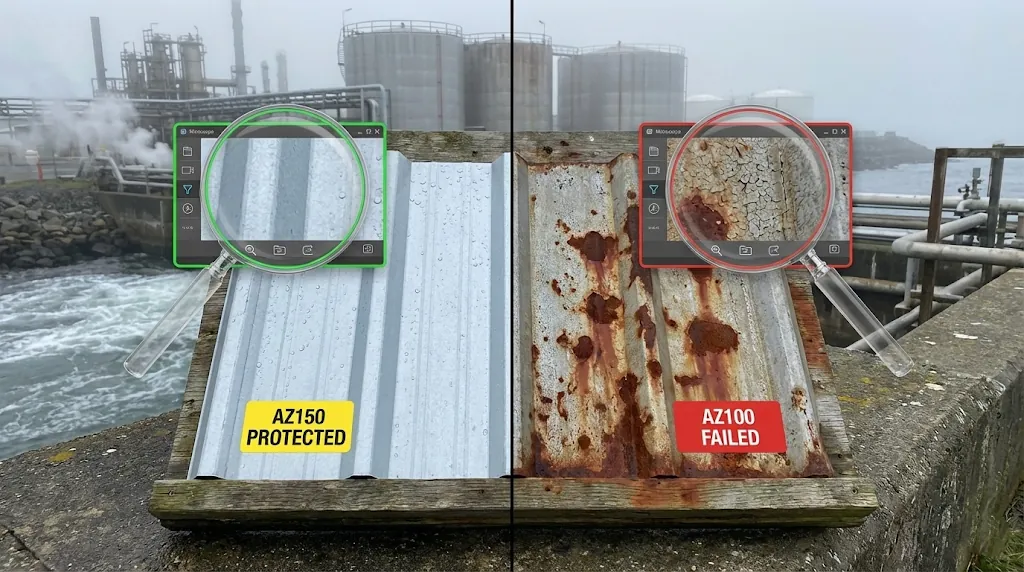
In environments with high chloride levels (coastal) and acids (chemical plants), coating thickness becomes a critical factor. AZ150 provides a much larger cathodic protection reserve compared to AZ100, thus able to withstand higher corrosion rates.
Point 2: Environmental Factors of Chemical Plants and Coastal Areas
Sub-point 2.1: Exposure to Corrosive Chemicals in Chemical Plants
Chemical plants produce various corrosive compounds such as sulfuric acid (H₂SO₄), hydrochloric acid (HCl), ammonia (NH₃), and organic solvents. Vapors and fine particles of these compounds can adhere to roof surfaces and accelerate coating degradation. Acid attack on the zinc and aluminium layer can cause pitting corrosion and premature peeling.
Sub-point 2.2: Coastal Conditions: High Salt Content, Humidity, Sea Breeze, and Wet-Dry Cycles
Coastal areas have unique corrosive characteristics:
- Salt aerosol (chloride): Chloride concentration in the air can reach 100–500 mg/m²/day in the surf zone.
- High humidity: Relative humidity (RH) is often above 80%, accelerating electrochemical reactions.
- Wet-dry cycles: Evaporation of seawater leaves hygroscopic salt crystals, maintaining an electrolyte layer on the metal surface.
- Sea breeze: Carries salt and sand particles that can mechanically abrade the coating.
Sub-point 2.3: Differences in Atmospheric Corrosion Rates Based on ISO 9223 Categories
ISO 9223 classifies atmospheric corrosivity into several categories:
- C4 (High): Carbon steel corrosion rate 25–50 µm/year. Example: coastal areas with moderate salt levels.
- C5 (Very High): Corrosion rate 50–80 µm/year. Example: direct coastal areas (surf zone) and chemical plants.
- CX (Extreme): Corrosion rate >80 µm/year. Example: chemical plants with high corrosive emissions, tropical coastal areas with extreme humidity.
In categories C5 and CX, AZ100 coating has a much higher risk of premature failure compared to AZ150.
Sub-point 2.4: Impact of Corrosion Accumulation on Roof Structure Integrity
Uncontrolled corrosion can cause:
- Reduction in steel thickness: Reduces the load capacity of the structure.
- Loss of tensile strength: Corroded light steel loses its mechanical strength.
- Roof leakage: Disrupts plant operations and damages equipment underneath.
- Safety risks: Roof structure failure can endanger workers and assets.
Point 3: Life-Cycle Cost (LCC) Analysis Methodology
Sub-point 3.1: Initial Cost Components
Initial costs include:
- Material: Price of AZ150 vs AZ100 light steel. AZ150 is generally 8–15% more expensive per ton.
- Installation: Labor and equipment costs.
- Transportation: Logistics to the project site.
Sub-point 3.2: Preventive and Corrective Maintenance Costs
- Inspection: Visual inspection and coating thickness measurement.
- Repainting: Required if the coating begins to degrade.
- Panel replacement: For areas with severe corrosion.
AZ100 in C5/CX environments requires more frequent maintenance, with inspection intervals of 6–12 months and repainting every 3–5 years.
Sub-point 3.3: Total Replacement Cost and Service Life
- AZ150: Service life 25–40 years in C5, 20–30 years in CX.
- AZ100: Service life 10–20 years in C5, 5–15 years in CX.
Total roof replacement involves material, labor, and operational disruption costs that are very large.
Sub-point 3.4: Indirect Costs
- Production downtime: Lost revenue due to plant operational stoppage.
- Revenue loss: Estimated Rp 50–500 million per day for medium-scale chemical plants.
- Safety risks: Costs of workplace accidents and insurance claims.
Sub-point 3.5: Discounted Time Value of Money Method
LCC analysis uses:
- Net Present Value (NPV): Present value of all costs over the analysis period.
- Internal Rate of Return (IRR): Investment rate of return.
- Payback Period: Time required to recover the initial investment.
Commonly used discount rates are 8–12% per year.
Point 4: Performance and Service Life Comparison
Sub-point 4.1: Estimated Service Life of AZ150 vs AZ100
Based on field test data of PT. Bajaringan Industri Sejahtera (2020–2024):
| Environment | AZ150 | AZ100 |
|---|---|---|
| C4 (moderate coastal) | 30–40 years | 15–25 years |
| C5 (direct coastal) | 25–35 years | 10–18 years |
| CX (chemical plant) | 20–30 years | 5–12 years |
Sub-point 4.2: Salt Spray Test (ASTM B117) and Cyclic Corrosion Test Results
- ASTM B117: AZ150 shows resistance >1500 hours without red rust, while AZ100 is around 800–1000 hours.
- Cyclic Corrosion Test (CCT): More representative of real conditions. AZ150 shows a 2–3 times advantage over AZ100 in terms of time to red rust appearance.
Sub-point 4.3: Resistance to Scratches, Bending, and Wind Load
- Scratches: AZ150 has more zinc reserve to protect scratched areas.
- Bending: Both coatings have good flexibility, but AZ150 is more resistant to micro-cracking.
- Wind load: Coating thickness does not directly affect structural strength, but accelerated corrosion in AZ100 can reduce load capacity over time.
Sub-point 4.4: Case Studies from PT. Bajaringan Industri Sejahtera Projects
Project A: Chemical plant in Cilegon (2020)
- Used AZ150 for sulfuric acid production area.
- After 4 years, inspection showed no red rust, coating thickness decreased <5%.
Project B: Coastal resort in Bali (2021)
- Used AZ100 for parking area roof.
- After 3 years, white rust and red rust spots were found at joints.
Point 5: Economic Analysis and Recommendations
Sub-point 5.1: LCC Calculation for 20, 30, and 40 Year Periods
Assumptions: Roof area 5,000 m², discount rate 10%.
| Period | AZ150 (NPV) | AZ100 (NPV) |
|---|---|---|
| 20 years | Rp 2.8 billion | Rp 3.5 billion |
| 30 years | Rp 3.2 billion | Rp 5.1 billion |
| 40 years | Rp 3.6 billion | Rp 7.3 billion |
Sub-point 5.2: Total Cost of Ownership Comparison
Total cost of ownership (TCO) of AZ150 is 20–50% lower than AZ100 for periods >20 years in C5/CX environments.
Sub-point 5.3: Break-Even Point
AZ150 becomes more economical after 8–12 years in C5 environments, and 5–8 years in CX environments.
Sub-point 5.4: Usage Recommendations
- AZ150: Mandatory for direct coastal areas (C5) and heavy chemical plants (CX).
- AZ100: Suitable for moderate corrosive environments (C3–C4), such as light industrial cities or protected coastal areas.
Sub-point 5.5: Additional Mitigation Strategies
- Additional coating: Painting with epoxy or polyurethane paint.
- Drainage design: Ensuring no water pooling on the roof surface.
- Regular maintenance: Inspection and cleaning at least twice a year.
Point 6: Implications for PT. Bajaringan Industri Sejahtera
Sub-point 6.1: Product Differentiation and Selling Value
PT. Bajaringan can position AZ150 as a premium solution for high-corrosive industry segments, by highlighting LCC analysis as a sales tool.
Sub-point 6.2: LCC-Based Technical Sales Guidelines
The sales engineering team needs to be equipped with a simple LCC calculator and real case studies to convince customers.
Sub-point 6.3: Opportunities for Collaboration with Chemical Plants and Coastal Projects
Certifications and project references in the chemical and coastal sectors will strengthen PT. Bajaringan's credibility.
Sub-point 6.4: Warranty Risks and Customer Expectation Management
Product warranties must be adjusted to the installation environment. AZ100 in CX environments will increase the risk of warranty claims.
3. Conclusion
AZ150 coating is significantly superior in corrosion resistance and service life compared to AZ100, especially in aggressive chemical plant and coastal environments. Although the initial cost of AZ150 is higher, life-cycle cost analysis shows long-term savings through reduced maintenance and replacement. PT. Bajaringan Industri Sejahtera is recommended to position AZ150 as a premium solution for high-corrosive industry segments, while still providing AZ100 for applications with moderate corrosion risk.
4. References
- ASTM A792/A792M – Standard Specification for Steel Sheet, 55% Aluminum-Zinc Alloy-Coated by the Hot-Dip Process.
- ISO 9223:2012 – Corrosion of metals and alloys – Corrosivity of atmospheres – Classification, determination and estimation.
- AS/NZS 1365:1996 – Steel sheet and strip – Hot-dip zinc-coated or aluminium/zinc-coated.
- SNI 4096:2007 – Baja lembaran lapis seng-aluminium (BjLAS).
- Zhang, X.G. (1996). Corrosion and Electrochemistry of Zinc. Plenum Press.
- Internal study of PT. Bajaringan Industri Sejahtera (2020–2024) – Field test data and coastal projects.
- El-Reedy, M.A. (2012). Steel-Reinforced Concrete Structures: Assessment and Repair of Corrosion. CRC Press.
Dapatkan Update
Artikel terbaru, insight harga material, dan studi kasus proyek langsung ke WhatsApp Anda.
Artikel Terkait
Lihat Lainnya
Comparison of Klip-Lok vs Trimdek Roof Profiles for Warehouses and Factories: Advantages of the Concealed Clip System, Durability, Price, and Usage Recommendations
Introduction Roofing is a crucial component in the construction of warehouses and factories. Its function is not merely …
Building Industry Without Burden: Why Light Steel Roof Structures Are the Best Investment for Your Warehouse and Factory
Introduction In the warehouse and factory construction industry, space efficiency and structural strength are top priori…
How Long is the Warranty for Warehouse Roofing Materials and Installation Services at PT. Bajaringan Industri Sejahtera?
How Long is the Warranty for Warehouse Roofing Materials and Installation Services at PT. Bajaringan Industri Sejahtera?…
NEED A COST ESTIMATE FOR YOUR PROJECT?
Our surveyors come to the location for free written offers within 24 hours.