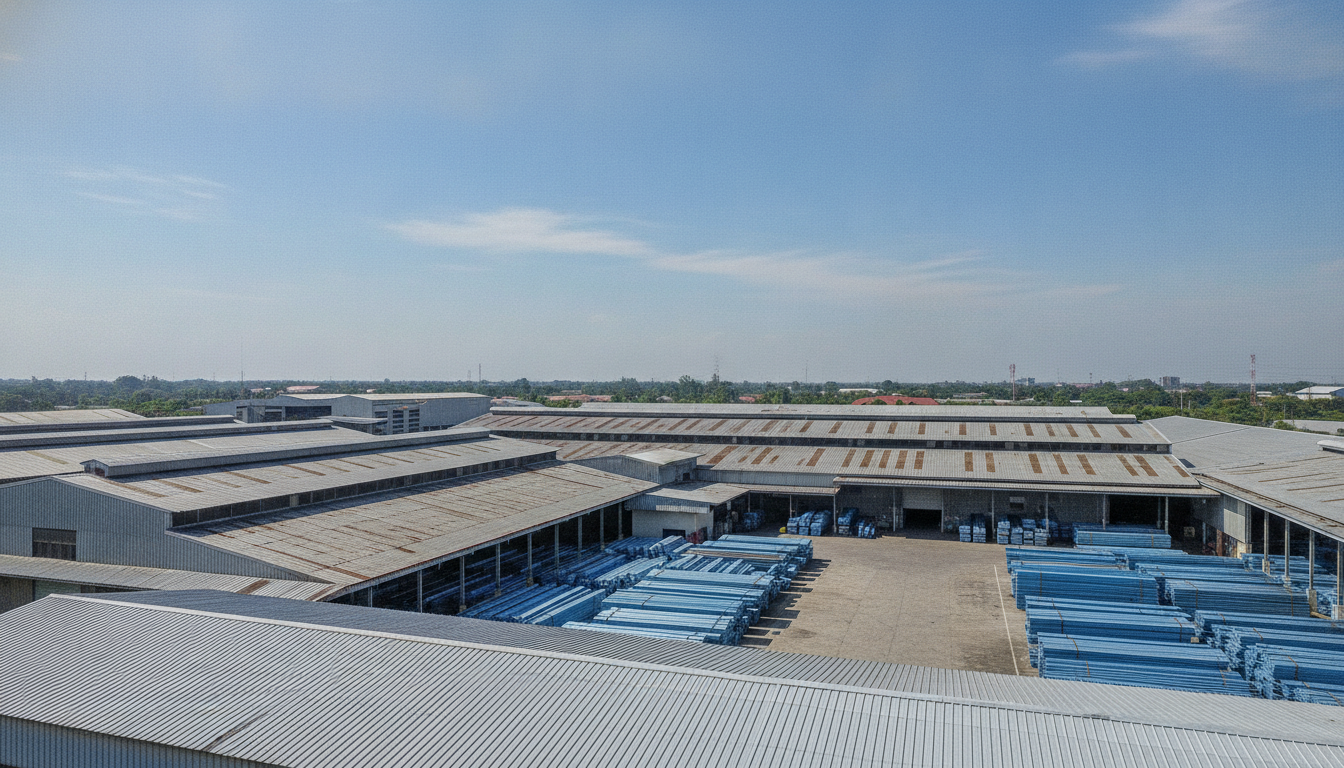
12-Year-Old Warehouse Roof Starting to Leak: Partial Repair or Full Replacement? Here's the Cost Calculation
Introduction
A warehouse roof that has reached 12 years of age and begun to leak often presents a classic dilemma for facility owners and managers: should you patch the damaged sections, or replace the entire roof at once? This decision should not be taken lightly, as it involves three critical factors at once — cost, safety, and the continuity of warehouse operations.
As a contractor specializing in light steel roofing, PT. Bajaringan Industri Sejahtera has guided dozens of companies through this exact situation. Our experience shows that the right decision depends heavily on the actual extent of damage, the condition of the light steel frame, and the life cycle cost calculation — not merely on the lower upfront price tag.
This article compares both options objectively, complete with cost simulations, so you can make the most economical and appropriate decision for your warehouse.
a. Identify the Cause and Extent of Roof Damage Before Deciding
The first mandatory step is a thorough inspection. Without accurate damage data, a repair-or-replace decision is nothing more than a guess.
Identify the source of the leak. Leaks in metal roofs typically originate from several critical points:
- Joint seams whose sealant has hardened and cracked after 10+ years of UV exposure.
- Loose or dislodged screws due to thermal movement and daily expansion-contraction cycles.
- Corroded sheets, especially in areas prone to water pooling or near chimneys.
- Flashing and gutters that are clogged or already perforated.
Inspect the condition of the light steel frame. This is the primary determining factor. A light steel frame (typically C75, C100, or C125 profiles with 0.75–1.00 mm thickness and G550/Z220–Z275 galvanized coating) that remains sturdy and corrosion-free means replacing the roof covering alone is sufficient. However, if widespread corrosion, deformation, or loosening joints are found, full replacement becomes more rational.
Distinguish the scale of damage:
- Local damage (below 20% of the area): usually still worth repairing.
- Widespread damage (spread across many points, especially if the material has exceeded 10–15 years): full replacement is more economical.
b. Option 1 — Partial Repair: When Is It Still Viable?
Partial repair is suitable when damage is localized and the light steel frame remains in good condition.
Common repair work:
- Replacing damaged roof sheets (typically 5–20% of total area).
- Patching with polyurethane sealant or butyl tape at joints.
- Tightening or replacing loose self-drilling screws.
- Repairing gutters and flashing.
Estimated cost: generally 15–30% of the full replacement cost, depending on the area repaired.
Advantages:
- Much lower upfront cost.
- Short work duration (1–3 days for a 1,000 m² warehouse), minimizing operational disruption.
Disadvantages:
- High risk of new leaks at other points, as the material is nearing its limit.
- Potential for repeated repairs within the next 1–2 years, which if accumulated could exceed the full replacement cost.
c. Option 2 — Full Replacement: When Is It the More Economical Choice?
Full replacement is recommended when damage is widespread, the frame is beginning to corrode, or the roof has passed its economic lifespan (10–15 years for metal roofs).
Scope of work:
- Dismantling the old roof (including material disposal).
- Inspecting and repairing the light steel frame (reinforcement, replacement of corroded profiles, joint checks).
- Installing the new roof (spandek, sand-coated metal, or insulated metal roofing).
- Renewing accessories: gutters, flashing, ridge caps, and insulation.
Estimated cost: higher upfront, but eliminates recurring repair costs and reduces the risk of goods damage from leaks.
Advantages:
- New material warranty (typically 10–20 years).
- Better thermal and waterproof performance (especially with insulated metal roofing).
- Increased warehouse asset value.
Disadvantages:
- High upfront cost.
- Requires scheduling so warehouse operations are not disrupted.
d. Cost Calculation: Repair vs. Replacement Simulation
Basic formula:
Total cost = (area × material unit price) + dismantling-installation labor + accessories + contingency (5–10%)
Simulation example for a 1,000 m² warehouse:
| Component | Partial Repair (20% area) | Full Replacement |
|---|---|---|
| Area | 200 m² | 1,000 m² |
| Installed unit price | IDR 150,000–250,000/m² | IDR 350,000–550,000/m² |
| Material + labor | IDR 30–50 million | IDR 350–550 million |
| Contingency (10%) | IDR 3–5 million | IDR 35–55 million |
| Initial investment | ± IDR 33–55 million | ± IDR 385–605 million |
| Recurring repairs (every 1.5 years) | 3× in 5 years ≈ IDR 100–165 million | — |
| Total 5-year cost | ± IDR 133–220 million | ± IDR 385–605 million (one-time) |
Life cycle cost analysis:
Although full replacement appears much larger, note that recurring repairs over 5 years can absorb IDR 133–220 million — nearly half the full replacement cost — without permanently solving the problem. After 5 years, the old roof still needs replacement, meaning total expenditure would actually be higher than replacing upfront.
Hidden costs often overlooked:
- Goods damage from leaks (can reach tens to hundreds of millions depending on the commodity).
- Production downtime during recurring repairs.
- Workplace accident risk from a fragile roof.
- Insurance premium increases or claim rejections due to poor roof condition.
e. Non-Cost Factors That Must Be Considered
- Safety: A fragile roof risks collapse and endangers workers and goods. A corroded light steel frame loses structural capacity significantly.
- Regulation and insurance: Some property insurance policies require a roof in proper condition. A leaking roof can void claims.
- Asset value and corporate image: A new roof increases warehouse resale value and client trust, especially for warehouses audited by principals or business partners.
- Maintenance ease: New roof materials are generally easier to maintain and come with official warranties.
f. PT. Bajaringan Industri Sejahtera's Recommendation: Cost-Effective Solutions for Your Condition
As a light steel roofing specialist, PT. Bajaringan Industri Sejahtera offers solutions tailored to your warehouse's actual condition:
- Free roof inspection and audit to accurately determine the extent of damage — including checks on the light steel frame, joints, and accessories.
- Two transparent packages: selective repair and full replacement, complete with detailed RAB (cost budget plans) for direct comparison.
- Quality light steel materials with SNI-compliant galvanized coating and official warranties, installed by certified teams.
- Flexible payment options and work schedules adjusted to keep warehouse operations running.
We believe the best decisions come from data, not assumptions. That's why a roof audit is the first step we recommend to every client.
Conclusion
There is no single answer that applies to every warehouse. Partial repair is more economical when damage is still local and the light steel frame is sturdy. Full replacement is more economical in the long run when damage is widespread or the roof is nearing the end of its service life.
The key is a thorough inspection and life cycle cost calculation, not merely looking at the upfront cost. PT. Bajaringan Industri Sejahtera is ready to help you calculate the most economical option through a roof audit and transparent RAB preparation.
Note: The cost simulations in this article are illustrative and should be adjusted to actual prices, warehouse area, and field conditions at the time of publication.
References
- Indonesian National Standards (SNI) related to light steel construction and roof coverings.
- Building maintenance guidelines (Permen PUPR).
- Technical literature from metal roofing and light steel material manufacturers.
- Local material and construction service unit price data (updated periodically).
Dapatkan Update
Artikel terbaru, insight harga material, dan studi kasus proyek langsung ke WhatsApp Anda.
Artikel Terkait
Lihat Lainnya
Which Is Safer: Lump Sum or Per-Square-Meter Pricing for Installing My Warehouse Roof?
Which Is Safer: Lump Sum or Per-Square-Meter Pricing for Installing My Warehouse Roof? Introduction Choosing the paymen…
Is It Safer to Use a Lump-Sum or Per-Square-Meter System for Installing Your Warehouse Roof?
Is It Safer to Use a Lump-Sum or Per-Square-Meter System for Installing Your Warehouse Roof? Choosing the right payment …
What Is the Total Cost of Warehouse Roof Installation per Square Meter This Year? Including Frame and Labor
What Is the Total Cost of Warehouse Roof Installation per Square Meter This Year? Including Frame and Labor Introductio…
NEED A COST ESTIMATE FOR YOUR PROJECT?
Our surveyors come to the location for free written offers within 24 hours.