Replacing a Factory Roof Without Stopping 24/7 Operations: Dust-Free and Safe Strategies from PT. Bajaringan Industri Sejahtera
Introduction
In modern manufacturing, 24/7 production continuity is non-negotiable. Every minute a machine stops means financial loss, lost client trust, and supply chain disruption. Yet when a factory roof leaks, corrodes, or requires renovation due to age, concerns about machine downtime and dust contamination often become the main obstacle. Many plant managers delay roof repairs for fear of disrupting operations—when in fact delay only increases the risk of greater damage.
This article will discuss strategic methods for roof replacement that are safe, efficient, and proven to maintain operational stability and production area cleanliness. PT. Bajaringan Industri Sejahtera, as a specialist in light steel structures for industrial buildings, has applied this approach to various textile, food, pharmaceutical, and electronics factories in the Jababeka, Cikarang, and Karawang industrial estates. Our focus is simple: a new roof without stopping production, without dust, and without compromising safety.
Point 1: The "Over-Roofing" Method (Roof Over Roof)
Definition
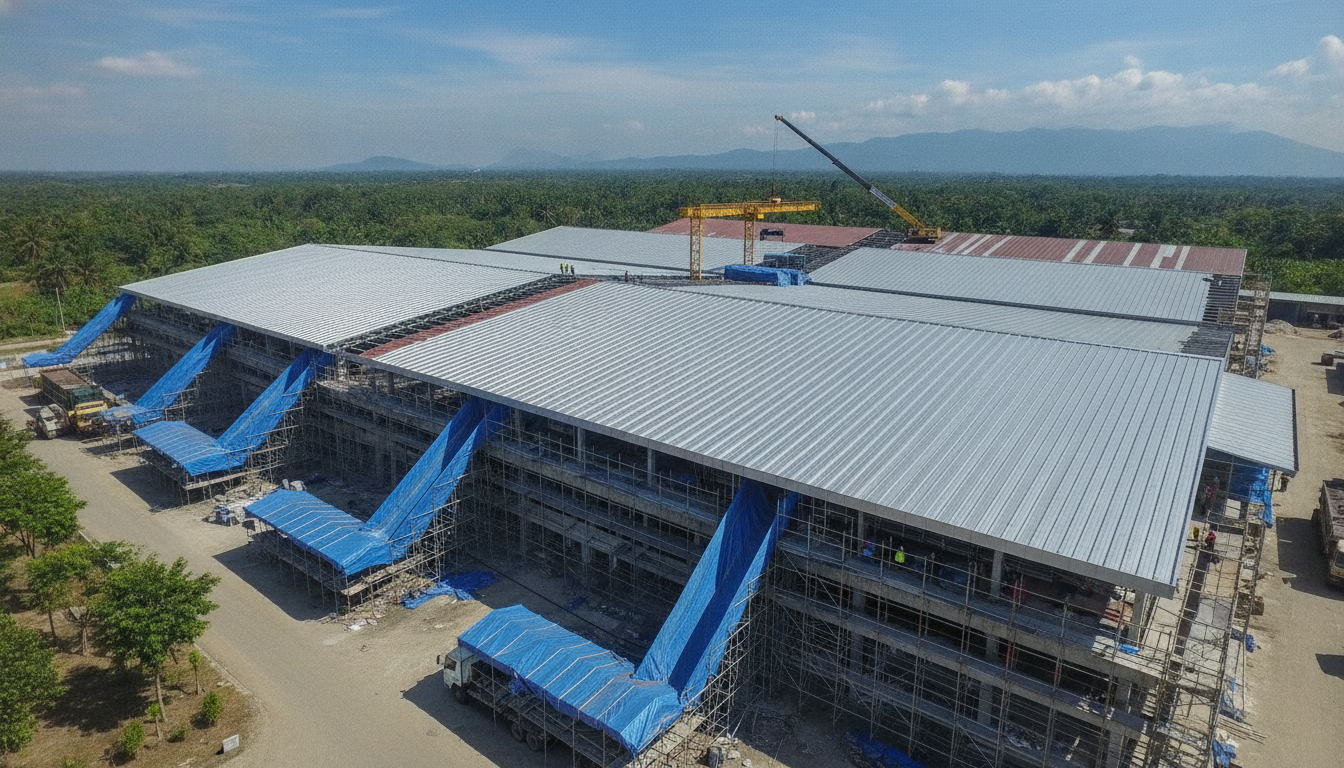
Over-roofing is a technique of installing a new light steel roof structure directly over the existing roof without demolishing the old roof first. The old roof continues to function as a temporary protective layer, while the new roof is installed above it with an independent frame system supported by columns or main structural walls.
Operational Advantages
- No Massive Demolition: Since the old roof is not demolished, there is no risk of sudden leaks or dust exposure to the production area below.
- Double Protection: During construction, the old roof continues to protect machines and products from weather. Once complete, the new roof becomes the primary layer, and the old roof can be dismantled gradually or left as additional insulation.
- Production Continuity: Work can be done zone by zone, allowing the area below to continue normal production without significant disruption.
Light Steel Structure
Using high-quality light steel materials—such as C75, C100, or CNP profiles with AZ100 to AZ150 anti-corrosion coating—ensures the additional load remains safe for the main building structure. PT. Bajaringan Industri Sejahtera manufactures light steel frames with high precision tolerances, so installation over existing roofs can be done without major modifications to the main structure.
Time Estimate
With the over-roofing method, a 2,000 m² roof can be completed in 3–4 weeks with a zoning system, compared to 6–8 weeks if total demolition is required. This time can be further reduced with pre-fabrication of frames in our workshop.
Point 2: Phased Work Technique (Zoning System)
Area Division
Dividing the roof area into several zones (e.g., Zone A, B, and C) to be worked on alternately. Each zone has clear boundaries marked with marking lines and physical barriers. This approach allows the construction team to focus on one area without disturbing other zones still in operation.
Area Isolation
Installing tarps or temporary protective sheets below the work area to prevent falling materials or dust. We use thick polyethylene plastic (200–300 microns) installed with a hanging system on temporary frames, forming a "tent" below the work point. This is the first line of defense against contamination.
Flexible Schedule
Heavy work is focused on certain hours (e.g., night shift) or when machines in that zone are undergoing routine maintenance. Coordination with the production team allows precise scheduling—for example, drilling and cutting are done when machines below are not operating due to scheduled maintenance.
Internal Coordination
Synchronization between the construction team and production team to ensure no overlapping risky activities. We place a project coordinator who serves as the liaison between the site manager and plant manager, with daily briefings every morning before the shift begins.
Point 3: Integrated Dust Control System
Dust is the main enemy of food, pharmaceutical, and electronics factories. One metal particle or concrete chip falling onto a production line can cause product defects or even a recall. Here is the dust control system we implement:
Use of Sheet Pile/Protective Plastic
Sealing the area below cutting or drilling points tightly with thick plastic to contain debris. Plastic is installed with a "double layer" system—the first layer catches large debris, the second layer catches fine particles.
Low-Dust Cutting Tools
Using light steel cutting machines equipped with dust collectors or cold cutting techniques. We also use hydraulic shears and scissors to minimize metal dust, as well as drills with integrated vacuum systems.
Industrial Vacuum
Placing industrial vacuum units around the work area to capture airborne fine particles. These units operate throughout working hours and are placed at strategic points below the work zone.
Water Spraying
Spraying mist water in the outer work area to suppress dust from entering factory ventilation. This misting system uses fine nozzles producing 10–50 micron droplets, enough to suppress dust without wetting the production area.
Air Quality Monitoring
We install particle counters in the production area to monitor PM2.5 and PM10 concentrations in real-time. If thresholds are exceeded, work is temporarily stopped and the dust control system is evaluated.
Point 4: Proper Structural and Material Planning
Load Analysis
Structural calculation by engineers to ensure the new light steel frame can support the additional roof load and wind load. We use structural analysis software (such as SAP2000 or ETABS) to model dead loads, live loads, wind loads, and seismic loads according to SNI 1727:2020 and SNI 1726:2019.
Quality Materials
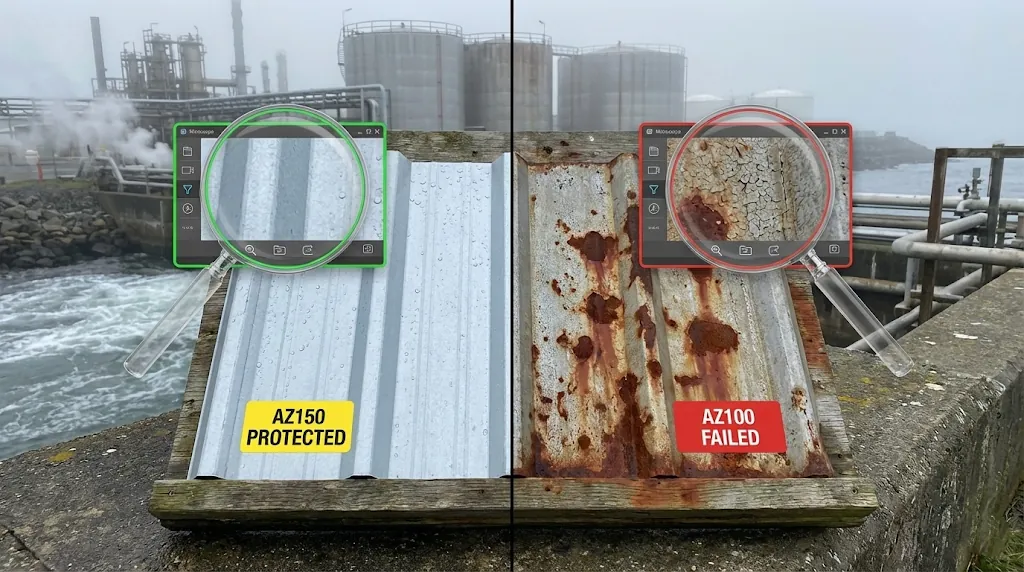
Selection of light steel profiles (C75, C100, or CNP) with anti-corrosion coating (AZ100 or higher) to ensure long service life even in industrial environments. Light steel with AZ150 coating has corrosion resistance up to 30 years in moderate industrial environments. PT. Bajaringan Industri Sejahtera produces profiles according to SNI 7971:2016 standards and conducts regular tensile and coating tests.
Connection System
Use of self-drilling screws and special brackets that allow quick installation without welding (which produces sparks and smoke). Screw connections also facilitate inspection and component replacement in the future.
Ventilation
The new roof design must account for air circulation (turbine ventilators) to keep factory temperature stable. We recommend adding turbine ventilators with a capacity of 1 unit per 20–25 m² of roof area, plus ridge vents to expel trapped hot air.
Drainage System
Adequate gutter and downspout design to prevent water pooling on the new roof, which can accelerate corrosion and add structural load.
Point 5: Occupational Safety and Health (K3) Protocol and Risk Management
Safety Induction
All construction workers must understand restricted areas and factory evacuation routes. We conduct safety induction before the project begins, covering: fire extinguisher locations, evacuation routes, assembly points, restricted areas, and lockout/tagout procedures when working near machines.
Safety Net
Installation of nets below the work area to prevent workers or materials from falling onto machine areas. Nets are installed with a strong suspension system and load-tested before work begins.
Route Separation
Separating construction worker traffic from forklift or factory employee operational routes. We use physical barriers and clear safety signs, and establish special hours for material transport.
Strict Supervision
Supervisors monitor compliance with cleanliness and safety standards throughout the project. Our supervisors are equipped with daily checklists covering: work area cleanliness, worker PPE condition, safety net condition, and compliance with the zoning schedule.
Risk Management
We conduct HIRADC (Hazard Identification, Risk Assessment, and Determining Control) before the project begins, as well as JSA (Job Safety Analysis) for each high-risk task. All these documents are approved by the client's K3 team before work begins.
Conclusion
Replacing a factory roof without stopping 24/7 production is not impossible if done with the right methods. By combining over-roofing techniques, zoning management, strict dust control systems, and quality light steel materials, roof renovation can proceed smoothly without sacrificing productivity. The key to success lies in careful planning, close coordination between construction and production teams, and commitment to safety and cleanliness standards.
PT. Bajaringan Industri Sejahtera is ready to be a strategic partner in providing safe, fast, and clean roof solutions for your industry. With over a decade of experience, certified engineer teams, and SNI-standard light steel production facilities, we have helped dozens of factories in West Java and Banten maintain production during roof renovations. Contact us for free consultation and site survey.
References
- Indonesian National Standard (SNI) 7971:2016 on Light Steel Specifications for Building Structures.
- Indonesian National Standard (SNI) 1727:2020 on Minimum Design Loads for Buildings.
- Indonesian National Standard (SNI) 1726:2019 on Seismic Resilience Planning Procedures for Building Structures.
- Minister of Manpower Regulation No. 5 of 2018 on Occupational Safety and Health in the Work Environment.
- Construction Industry Institute (CII). (2020). Best Practices for Plant Turnaround and Maintenance.
- Metal Roofing Alliance. (2021). Retrofit Roofing: Installing Over Existing Roofs.
- Internal Case Study of PT. Bajaringan Industri Sejahtera (2023). Over-Roofing Implementation at a Textile Factory in Jababeka Industrial Estate.
Dapatkan Update
Artikel terbaru, insight harga material, dan studi kasus proyek langsung ke WhatsApp Anda.
Artikel Terkait
Lihat Lainnya
Over-Roofing vs Tear-Off and Reinstall: The Best Solution for Warehouse Roof Renovation While Operations Continue
Introduction Renovating the roof of a warehouse that remains operational is both a technical and managerial challenge th…
How Long is the Warranty for Warehouse Roofing Materials and Installation Services at PT. Bajaringan Industri Sejahtera?
How Long is the Warranty for Warehouse Roofing Materials and Installation Services at PT. Bajaringan Industri Sejahtera?…
The Importance of Roof Audits Using Drone Technology and Thermal Inspection to Detect Leaks and Structural Damage Before Major Losses Occur
Introduction The roof is a vital building component that often goes unnoticed until damage becomes severe. In fact, the …
NEED A COST ESTIMATE FOR YOUR PROJECT?
Our surveyors come to the location for free written offers within 24 hours.