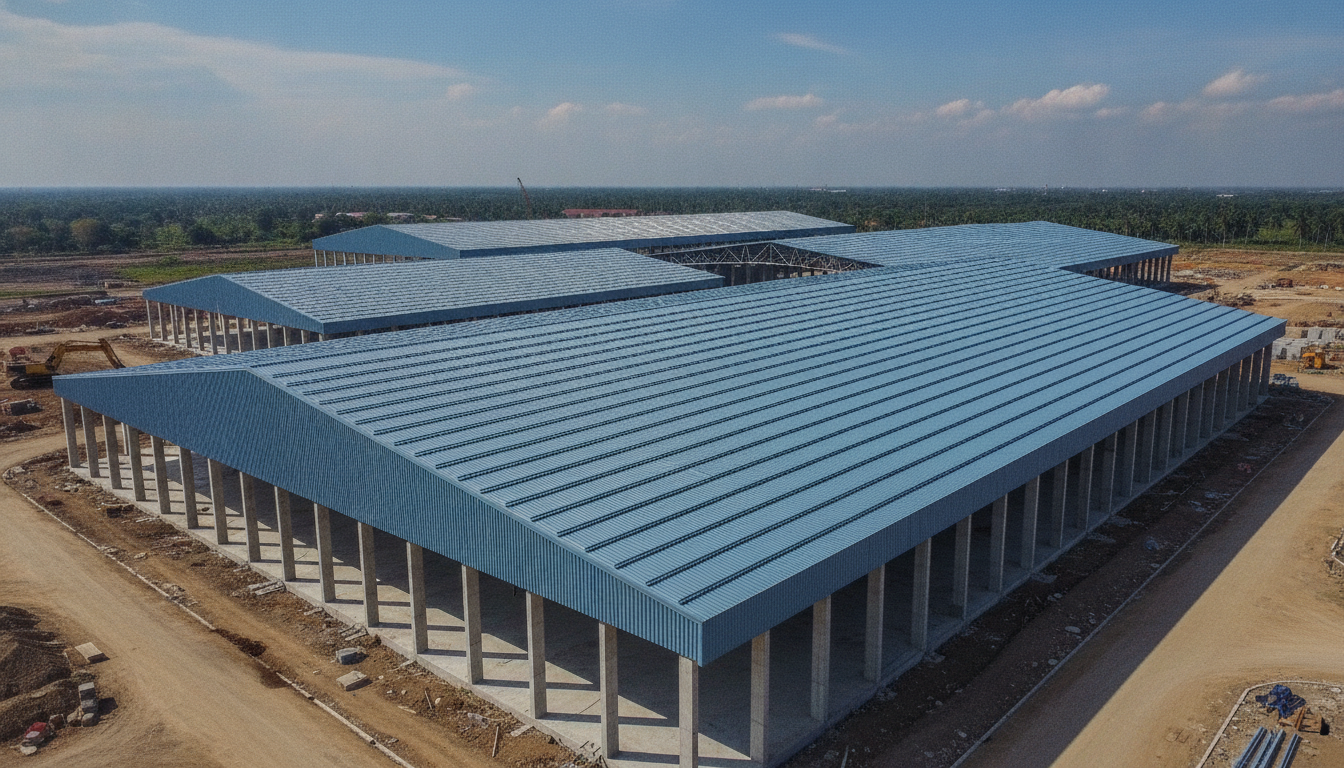
Ideal Warehouse Roof Slope & Purlin Spacing: 1 Meter or 1.2 Meters?
Introduction
Roof slope and purlin spacing are two crucial factors that determine the strength, durability, and cost efficiency of warehouse construction. Many customers of PT. Bajaringan Industri Sejahtera ask what the ideal slope angle is and whether purlin spacing should be 1 meter or 1.2 meters. Questions like "Sir, what is the ideal roof slope in degrees for my warehouse? And should the purlin spacing be 1 meter or 1.2 meters?" are very common, and this is natural because both parameters are closely interrelated with the overall structural performance. This article will discuss both aspects technically and practically so you can make the right, safe, and efficient decision for your warehouse project.
As a company experienced in light steel roof trusses, PT. Bajaringan Industri Sejahtera understands that decisions regarding roof slope and purlin spacing cannot be made arbitrarily. Meticulous structural calculations, an understanding of roof covering types, and consideration of local environmental conditions are required. Let us discuss them one by one.
Point 1: Ideal Warehouse Roof Slope Based on Roof Covering Type
Warehouse roof slope cannot be standardized for all types of roof coverings. Each material has different characteristics and minimum slope standards. Here is a general guide used in light steel construction practice:
- Metal/spandek roofing: The minimum slope standard is 5–10 degrees with proper overlap. However, for optimal performance and long-term durability, the ideal slope for warehouses with spandek covering is in the range of 10–15 degrees.
- Metal tiles: Require a minimum slope of 12–15 degrees because the metal tile profile needs a certain angle for the inter-panel locking system to work optimally and prevent water seepage.
- Indonesian climate considerations: With high rainfall throughout the year, a minimum slope of 10 degrees is recommended so that rainwater can flow smoothly to the drainage channel without obstruction.
- Risks of too-low slope: A slope below 5 degrees is very risky for causing leaks and water ponding on the roof surface. Ponding not only accelerates corrosion but also adds dead load to the structure that can trigger excessive deflection.
Point 2: Factors Influencing Roof Slope Selection
Determining warehouse roof slope is not merely following standard numbers. Several factors must be considered simultaneously:
- Type and profile of roof covering: Each spandek or metal tile manufacturer typically specifies the minimum recommended slope in their product specifications. Ignoring this recommendation may void the product warranty.
- Warehouse roof span: The wider the span, the greater the bending moment. A slope that is too low on a wide span will increase the risk of deflection and require larger steel profiles.
- Wind load and rainfall at the project location: Areas with high wind speeds require special consideration, including a slope that is not too steep to reduce uplift forces while still being sufficient for drainage.
- Aesthetics and space requirements: A steeper slope provides additional volume under the roof, which can be utilized for air circulation or storage. However, a steep slope also increases the need for wall and truss materials.
- Local building regulations and SNI standards: Ensure the design complies with SNI 1727:2020 on minimum design loads and SNI 7971:2013 on cold-formed steel structures.
Point 3: Purlin Spacing 1 Meter vs 1.2 Meters — Technical Comparison
The question of whether purlin spacing should be 1 meter or 1.2 meters is one of the most frequently asked by customers. Both have advantages and different applications:
1-meter purlin spacing:
- Higher structural strength and stiffness because loads are distributed over more support points.
- Suitable for wide spans (above 15 meters) and areas with high wind loads.
- Allows the use of lighter light steel profiles (e.g., C75) for certain spans.
- Longer installation time and more material required, resulting in relatively higher costs.
1.2-meter purlin spacing:
- More economical in terms of material because fewer purlins are needed.
- Commonly used for warehouses with standard loads and normal spans (up to 15 meters).
- Requires thicker or larger light steel profiles (e.g., C100 or C125) to compensate for the wider spacing.
- Faster and more efficient installation time.
Effect on light steel profile thickness: A 1.2-meter purlin spacing generally requires C100 or C125 profiles with a minimum thickness of 0.75 mm to 1.00 mm, depending on span and load. Meanwhile, 1-meter spacing can use C75 profiles with 0.75 mm thickness for shorter spans. The selection of the right profile must be based on engineer calculations, not rough estimates.
Recommendations based on roof covering type and load: For spandek covering with standard loads, 1.2-meter spacing is sufficient. However, for heavier metal tiles or areas with strong wind loads, 1-meter spacing is more recommended.
Point 4: Relationship Between Roof Slope and Purlin Spacing
Roof slope and purlin spacing are not two independent variables. They influence each other and must be calculated in an integrated manner:
- Steeper slopes generally allow slightly wider purlin spacing because the dead load of the roof covering is distributed more evenly and shear forces at connections are smaller.
- Lower slopes require closer purlin spacing to prevent excessive deflection, especially because rainwater flows slowly and there is potential for ponding.
- Importance of integrated structural calculation: Using rules of thumb like "just use 1.2 meters" without calculation can be dangerous. Each project has a unique combination of loads.
- Case example: A warehouse with a 12-meter span and 10-degree slope requires a maximum purlin spacing of 1.2 meters with C100 profile at 0.80 mm thickness. If the slope is increased to 15 degrees, the purlin spacing can still be 1.2 meters with the same profile because load distribution is better. However, if the location is in an area with high wind loads, 1-meter spacing with C100 profile at 1.00 mm thickness becomes the safer choice.
Point 5: Standards and Recommendations of PT. Bajaringan Industri Sejahtera
As a specialist in light steel roof trusses, PT. Bajaringan Industri Sejahtera provides recommendations based on experience and technical standards:
- General company recommendation: A slope of 10–15 degrees with 1.2-meter purlin spacing for standard warehouses with spandek covering. This combination has proven to be safe, economical, and durable for most warehouse applications in Indonesia.
- 1-meter spacing is recommended for areas with high wind loads (coastal zones or highlands), spans above 15 meters, or the use of heavier roof coverings such as premium metal tiles.
- Free consultation and structural calculation services: Our engineering team is ready to help you calculate the optimal slope and purlin spacing according to your project specifications, at no additional cost.
- Importance of site survey: Before finalizing the design, we conduct a site survey to verify soil conditions, dominant wind direction, and installation access.
- Warranty and quality assurance: All light steel roof truss installations by PT. Bajaringan Industri Sejahtera come with a structural warranty and material quality guarantee in accordance with SNI standards.
Point 6: Common Mistakes to Avoid
Many warehouse roof problems occur due to mistakes in early decision-making. Here are some mistakes to avoid:
- Determining purlin spacing based solely on the cheapest price: Choosing 1.2-meter spacing with thin profiles to save costs actually risks causing deflection, leaks, and even structural failure.
- Ignoring local wind load and rainfall factors: Each location has different load characteristics. The same design may not be suitable for different locations.
- Not accounting for the roof covering type in the design: Using the same purlin spacing for spandek and metal tiles is a mistake that can reduce roof service life.
- Using light steel profiles with non-standard thickness: Ensure the profiles used have a minimum thickness in accordance with SNI 8399:2017 and are coated with anti-corrosion (galvanized or zincalume) of good quality.
Conclusion
The ideal warehouse roof slope is generally in the range of 10–15 degrees, while 1.2-meter purlin spacing is the economical choice for standard warehouses, and 1-meter spacing is for stronger structural requirements such as wide spans or areas with high wind loads. The final decision must be based on thorough structural calculations, the type of roof covering, and project site conditions. Do not hesitate to consult with the engineering team of PT. Bajaringan Industri Sejahtera to obtain a warehouse roof design that is safe, efficient, and within your budget. Contact us today for a free consultation and site survey.
References
- SNI 7971:2013 — Cold-Formed Steel Structures
- SNI 1727:2020 — Minimum Design Loads and Associated Criteria for Buildings
- SNI 8399:2017 — Light Steel Specification for Building Frames
- Technical Guide for Light Steel Roof Truss Installation (Indonesian Light Steel Association)
- Brochures and product catalogs of PT. Bajaringan Industri Sejahtera
Dapatkan Update
Artikel terbaru, insight harga material, dan studi kasus proyek langsung ke WhatsApp Anda.
Artikel Terkait
Lihat Lainnya
Should You Use a Roofing Specialist Contractor or Just Local Handymen for a 2,000 m² Warehouse?
Should You Use a Roofing Specialist Contractor or Just Local Handymen for a 2,000 m² Warehouse? Introduction Choosing t…
How Long is the Warranty for Warehouse Roofing Materials and Installation Services at PT. Bajaringan Industri Sejahtera?
How Long is the Warranty for Warehouse Roofing Materials and Installation Services at PT. Bajaringan Industri Sejahtera?…
The Importance of Roof Audits Using Drone Technology and Thermal Inspection to Detect Leaks and Structural Damage Before Major Losses Occur
Introduction The roof is a vital building component that often goes unnoticed until damage becomes severe. In fact, the …
NEED A COST ESTIMATE FOR YOUR PROJECT?
Our surveyors come to the location for free written offers within 24 hours.