Warehouse Roof at 12 Years and Starting to Leak: Partial Repair or Full Replacement? Here's the Calculation
Introduction
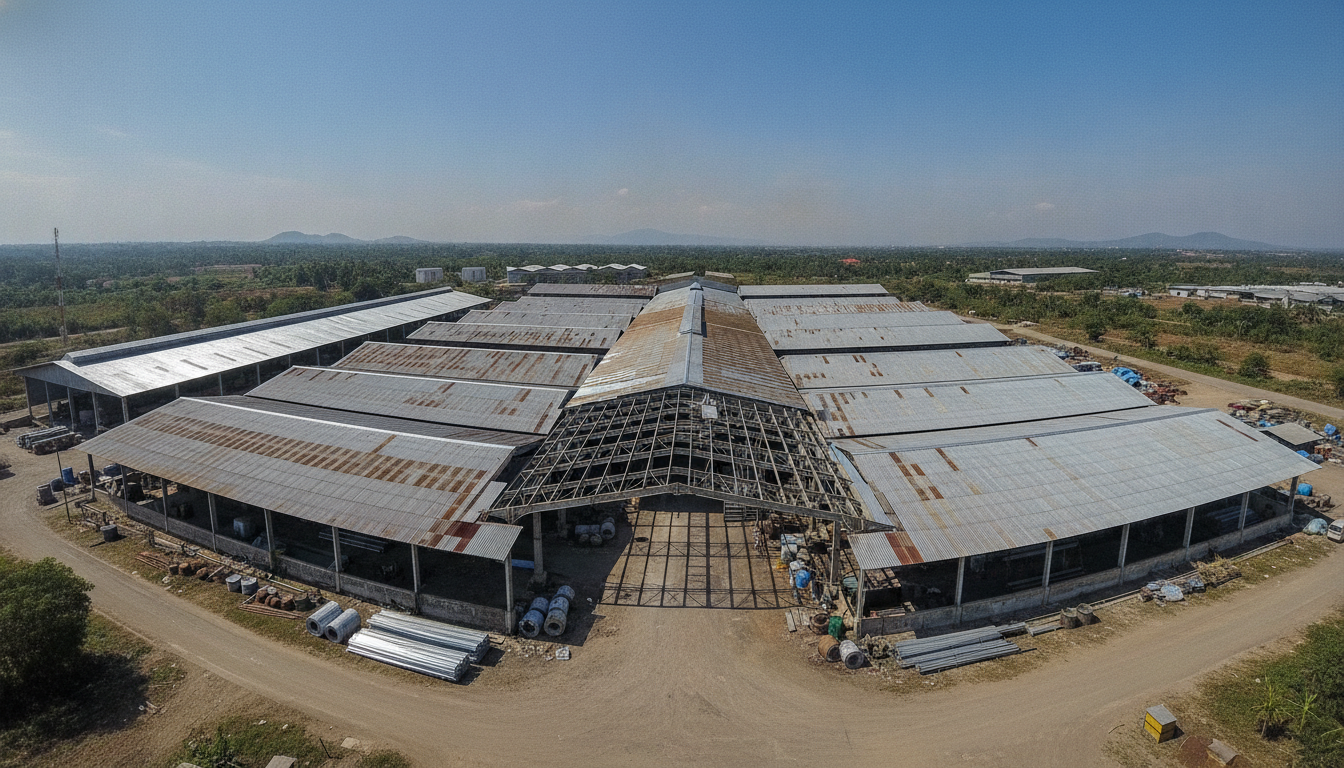
A warehouse roof that has reached 12 years of age and started leaking frequently is a common condition that creates a dilemma for many industrial building owners: should you repair partially or replace the entire roof? This decision should not be based on gut feeling alone, but on careful calculations of cost, risk, and service life. At 12 years, a metal roof has typically passed about 60–80% of its design life (usually 15–20 years for a quality metal roofing system with routine maintenance), so signs of material fatigue — corrosion, loosened screws, and widening seams — tend to appear uniformly rather than at a single point.
As a specialist in metal roofing, PT. Bajaringan Industri Sejahtera has guided many warehouse owners through data-driven decisions. This article presents a practical calculation framework — from inspection and cost-per-year analysis to decision thresholds — so you can choose the most economical long-term option, not just the cheapest upfront one.
1. Understand the Real Condition of the Roof First
Good decisions always start with accurate data. Before calculating costs, conduct a thorough inspection of the entire roof surface — not just the visibly leaking areas.
- Identify leak sources. Leaks in metal roofs typically originate from sheet overlaps, screw points with worn seals, clogged or corroded gutters, and sheet corrosion caused by condensation and weather exposure. Knowing the source determines whether the problem is local or systemic.
- Calculate the percentage of damaged area relative to total roof area. This is the primary basis for comparison. If leaks are isolated to 1–2 points covering less than 10% of the roof, partial repair remains rational. But if leak points are scattered across many zones, this indicates widespread material fatigue.
- Inspect supporting structures — purlins, girts, and the metal frame. Corrosion on purlins or girts is often more dangerous than the sheet leak itself. If supporting structures are affected, partial repair becomes ineffective because the roof's foundation is already weakened.
- Document findings with photos, location notes, and roof layout sketches. This documentation becomes the basis for written quotations and cost comparisons between contractors.
Technical tip from PT. Bajaringan: on a 12-year-old roof, check the steel sheet thickness (typically reduced by corrosion) and coating condition. Sheets below 0.35 mm thickness with peeling coating should no longer be patched, as patch durability will be very low.
2. Calculate the Full Cost of Partial Repair
Partial repair often looks cheap on the surface, but the calculation must be comprehensive:
- Patch/partial replacement material costs: replacement sheets (usually 1–3 per point), PU/silicone sealant, new self-drilling screws with EPDM seals, flashing, and accessories.
- Labor costs for limited demolition and installation, including team mobilization.
- Access and safety costs: scaffolding, harnesses, safety nets, and warehouse operational adjustments (areas beneath the roof must be temporarily cleared).
- Estimated service life of the repair: typically only 3–5 years before new leak points emerge elsewhere, due to uniform roof aging.
- Hidden risks: leaks migrating to other areas. Repeated repair costs (every 3–4 years) must be included in the total calculation, not ignored.
Illustration: a 1,000 m² warehouse with 8 scattered leak points. First-stage partial repair might cost IDR 30–45 million, but over 10 years there could be 2–3 repair cycles totaling IDR 90–135 million — not including operational disruption and inventory damage risk.
3. Calculate the Full Cost of Total Replacement
Total replacement is a large upfront investment but eliminates recurring repair costs:
- New roof material costs: metal sheets (0.40–0.50 mm thickness), insulation (if selected), flashing, gutters, and accessories — calculated per warehouse area.
- Old roof demolition and disposal costs (including transport and waste management).
- Labor costs and project duration: for a 1,000 m² warehouse, total replacement typically takes 3–6 weeks depending on conditions and weather. Consider potential operational disruption and schedule during low season.
- Residual value and warranty: new roofs typically come with 10–15 year warranties from material manufacturers and contractors, eliminating recurring repair costs during that period.
- Potential energy savings: if choosing insulated or reflective materials (e.g., metal sheets with reflective coating or glasswool insulation), warehouse interior temperatures can drop 3–5°C, saving cooling costs and protecting heat-sensitive goods.
4. Compare Using the "Cost per Year" Method
The fairest way to compare both options is cost per year:
Formula: Total cost (material + labor + operational disruption + risk) ÷ estimated service life.
Illustrative example (1,000 m² warehouse):
| Component | Partial Repair | Total Replacement |
|---|---|---|
| Initial cost | IDR 40 million | IDR 300 million |
| Service life per cycle | 4 years | 15 years |
| Number of cycles in 12 years | 3 times (IDR 120 million) | 1 time |
| Cost per year (single cycle) | IDR 10 million/year | IDR 20 million/year |
| Cost per year (12-year accumulation) | IDR 10 million/year + risk | IDR 20 million/year |
| Hidden costs | Inventory damage, repeated downtime, OHS risk | Minimal after replacement |
Nominally, partial repair appears cheaper per year. However, this figure does not yet include: (a) accumulated repeated repair costs, (b) inventory damage from leaks (a single major leak over an electronics storage area could cause tens to hundreds of millions in losses), (c) production downtime each time repairs occur, and (d) occupational accident risk on an increasingly fragile roof. When these factors are included, the effective cost of partial repair often approaches or exceeds total replacement — without providing certainty and peace of mind.
5. Consider Non-Financial Factors That Are Equally Important
- Inventory damage risk: warehouses store goods; a single major leak can cause losses far exceeding the roof cost itself.
- OHS compliance and insurance: a fragile roof increases workplace accident risk (worker falls, material collapse) and can affect property insurance premiums. Some insurers even reject claims caused by maintenance negligence.
- Operational disruption: repeated partial repairs are more disruptive than a single planned replacement scheduled during a slow period.
- Asset value and corporate image: a new roof increases building value, facilitates asset audits, and gives a professional impression to visiting clients.
- Regulations and permits: ensure total replacement complies with local building requirements (PBG/building permits) and SNI standards for metal roof construction.
6. Threshold-Based Decision Recommendations
Based on PT. Bajaringan Industri Sejahtera's experience across dozens of warehouse projects, here are practical thresholds to use as guidelines:
- Repair partially if: damaged area < 20–25% of roof area, supporting structures (purlins, girts, frame) are still sound, leaks are isolated, and roof age is under 10 years.
- Replace entirely if: damaged area > 30–40%, leaks are widely scattered, age approaches/exceeds design life (12+ years is a strong signal), or repeated repair costs within 3 years approach 40–50% of replacement cost.
- Hybrid option: replace by zone/in stages according to budget, prioritizing the most critical areas (above high-value inventory). Suitable for companies with cash flow constraints.
- Involve a metal roofing specialist for an audit and written quotation before deciding — do not decide based on a single quotation.
- Request a written warranty for whichever option is chosen, including material and installation warranties.
Conclusion
The decision between partial repair and total replacement of a warehouse roof must be based on inspection data, cost-per-year calculations, and consideration of operational and safety risks. In general, partial repair is more economical for isolated damage below 25% of area, while total replacement is more rational when damage is widespread and repeated repair costs keep accumulating — especially on a 12-year-old roof that is nearing the end of its design life.
PT. Bajaringan Industri Sejahtera is ready to assist with roof audits, transparent cost calculations, and data-driven recommendations so you can choose the most economical long-term solution. Contact our team to schedule an inspection and receive a written quotation.
References
- Indonesian National Standards (SNI) related to metal roof construction and roof coverings.
- Ministry of Public Works regulations on building requirements.
- Occupational Health and Safety (OHS) guidelines for roof work.
- Technical data and warranties for metal roofing products from material manufacturers.
- Internal case studies of PT. Bajaringan Industri Sejahtera.
Note: Figures in the illustrative examples are indicative and should be adjusted to actual prices, warehouse area, and field conditions at the time of publication.
Dapatkan Update
Artikel terbaru, insight harga material, dan studi kasus proyek langsung ke WhatsApp Anda.
Artikel Terkait
Lihat Lainnya
Peeking into Future Technology: How Thermal Drone Roof Audits Detect Leaks and Corrosion in Light Steel
Peeking into Future Technology: How Thermal Drone Roof Audits Detect Leaks and Corrosion in Light Steel Introduction Ma…
Complete Guide to Light Steel Roof Maintenance for Warehouses and Factories to Prevent Leaks and Corrosion
Introduction Light steel roofs are a vital component of warehouse and factory buildings as they function to protect asse…
How to Ensure the Light Steel Roofing Contractor You Choose Is Truly Experienced and Not a Fraud?
How to Ensure the Light Steel Roofing Contractor You Choose Is Truly Experienced and Not a Fraud? Introduction Choosing…
NEED A COST ESTIMATE FOR YOUR PROJECT?
Our surveyors come to the location for free written offers within 24 hours.